
Apartment EV Charging Rules in NSW, Victoria and Queensland
An apartment owner wants to install an EV charger in their parking space. The cable must cross common property.
In NSW, Victoria and Queensland, the same installation can require different approval processes.
NSW has a specific voting mechanism for sustainability infrastructure. Victoria's approval pathway depends on how the works affect common property. Queensland's rules depend on the body corporate regulation module and the type of improvement.
For apartment buyers and real estate agents, the distinction affects what can be promised about a property's EV charging capability.
Apartment EV charging approvals: NSW vs Victoria vs Queensland
NSW | Victoria | Queensland | |
Main legislation | Strata Schemes Management Act 2015 | Owners Corporations Act 2006 | Body Corporate and Community Management Act 1997 and applicable regulation module |
Who approves common property works? | Owners corporation | Owners corporation | Body corporate |
Key approval pathway | Sustainability infrastructure resolution for qualifying works | Ordinary or special resolution, depending on the nature of the works | Committee approval may be available for qualifying minor improvements; other works may require a general meeting |
Important threshold or distinction | Less than 50% of votes by unit entitlement must oppose a qualifying sustainability resolution | Maintaining or modernising common property can follow a different pathway from significantly changing its use | Under the Standard Module, qualifying owner improvements valued at $3,000 or less may receive committee approval |
What buyers should not assume | Proposed Right to Charge provisions are already in force | An approved EV strategy means permission for a private charger | Ownership of a parking space guarantees installation approval |
These are general rules, not a determination for any particular apartment.
The appropriate process depends on the scheme's documents, the location of the equipment, the proposed electrical work and the legislation applying to the property.
NSW: a specific approval mechanism for EV charging infrastructure
New South Wales expressly recognises electric vehicle charging stations as a form of sustainability infrastructure.
Under section 132B of the Strata Schemes Management Act 2015, an owners corporation can approve qualifying common property works through a sustainability infrastructure resolution.
A resolution passes if less than 50% of the value of votes cast, calculated by unit entitlement, is against it.
By comparison, a standard special resolution fails if more than 25% of the value of votes cast opposes the motion.
The difference is relevant when an owners corporation is considering shared electrical infrastructure, such as EV distribution boards, charging backbones or other qualifying building-wide improvements.

However, the lower voting threshold does not remove every other approval requirement. By-laws, funding decisions and the scope of common property works still need consideration.
NSW also restricts by-laws that prevent sustainability infrastructure solely because of its effect on external appearance. The restriction, introduced in July 2025, has exceptions for relevant heritage-listed properties and heritage conservation areas.
See the NSW Government's guidance on strata voting and strata by-laws.
Has NSW introduced a Right to Charge?
Not yet.
The Strata Schemes Legislation Amendment (Miscellaneous) Bill 2026 proposes a separate notification process for owners seeking to install EV charging equipment.
Under the proposed provisions, an owner would notify the strata committee of the intended installation. The committee would have a defined period to raise objections, with a mechanism for treating a failure to respond as no objection.
As at 14 October 2026, these provisions are not in force.
The NSW Parliament Bill Tracker lists the Bill as being before the Legislative Council.
An agent should therefore distinguish between a project that can proceed under existing sustainability infrastructure rules and an individual installation relying on rights that Parliament has not yet enacted.
Victoria: the nature of the works determines the resolution
In Victoria, EV charger approvals operate through the Owners Corporations Act 2006.
The key distinction is whether the proposed installation maintains or modernises existing common property infrastructure, or significantly changes the way common property is used.
The Victorian Government's September 2026 EV-ready guide for owners corporations explains how this affects approval.
Maintaining or modernising electrical infrastructure
An owners corporation may decide to upgrade shared electrical infrastructure so that individual parking spaces can be connected to chargers over time.
In suitable circumstances, this work can form part of maintaining or modernising common property.
The government guide explains that such works may be incorporated into the owners corporation's maintenance plan and approved by ordinary resolution.
That pathway may be appropriate for upgrading an existing switchboard, adding electrical distribution infrastructure or developing a common EV charging backbone.
The installation still needs to be assessed against the building's circumstances and applicable legal requirements.
Changing the use of common property
A different approval process applies when the work significantly changes the use or appearance of common property.
Examples include giving a particular lot owner exclusive use of a shared area or converting visitor parking spaces into charging spaces for individual owners.
These proposals generally require a special resolution.
Relevant upgrading works requiring planning or building permits also have specific special-resolution requirements.
The important point is that installing new EV infrastructure does not automatically determine the type of resolution required.
Two Victorian buildings installing similar charging equipment may need different approvals because the work affects their common property differently.
Who pays for the infrastructure?
Victoria's benefit principle adds another consideration.
Owners who receive a greater benefit from particular works may be required to contribute more.
The government guide describes a typical arrangement where shared electrical backbone infrastructure is funded according to lot liability, while individual chargers and their final connections are funded by the participating owners.
This is not a mandatory funding formula for every project. The appropriate allocation depends on the work, who benefits and the applicable legal requirements.
An owners corporation may therefore have an approved building-wide EV strategy without every individual installation being authorised or funded.
Queensland: the body corporate module and the improvement determine approval
Queensland's framework starts with two questions:
Which regulation module applies to the body corporate, and what part of the property will the installation affect?
A designated parking space might be part of the owner's lot or subject to exclusive-use rights over common property.
Even if the charger is physically mounted within a lot, its cabling may need to cross common property or connect to shared electrical infrastructure.
That can require body corporate authorisation.
When can a committee approve a charger?
Under section 187 of the Body Corporate and Community Management (Standard Module) Regulation 2020, an owner may seek permission to improve common property for the benefit of their lot.
A qualifying minor improvement can be authorised by the committee when all relevant conditions are met.
These include:
An installed value of $3,000 or less.
No detrimental effect on the appearance of a lot or common property.
The body corporate being satisfied that using the improvement is unlikely to promote a breach of the owner's duties as an occupier.
Where those conditions are not satisfied, an ordinary resolution at a general meeting is required under that section.
The body corporate may also impose conditions on the approval, and the owner has obligations concerning maintenance.
The $3,000 threshold is not automatic permission to install a charger.
It applies to a particular type of improvement under the Standard Module. Other regulation modules, exclusive-use arrangements and building-wide projects may involve different requirements.
For example, a body corporate proposing shared charging infrastructure is not necessarily making the same type of decision as a committee considering one owner's privately funded connection.
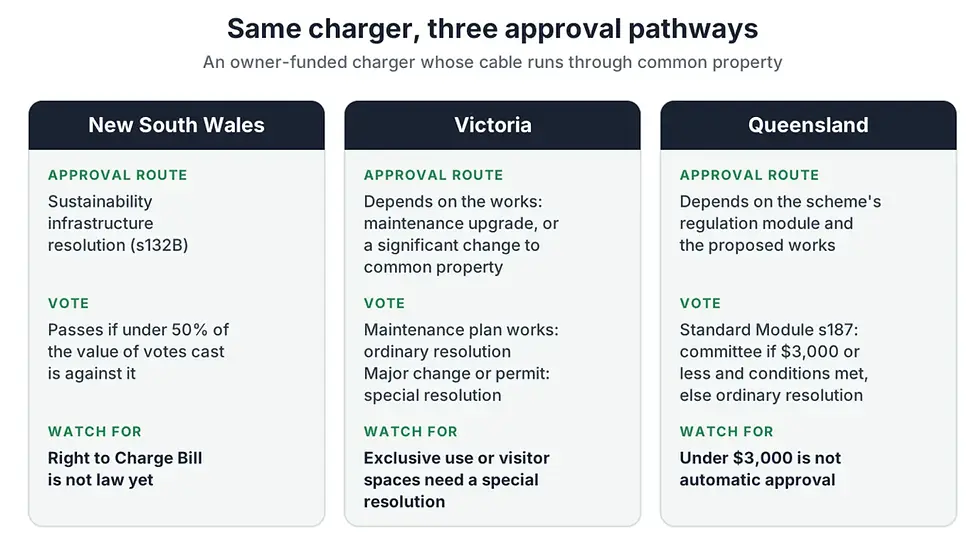
One proposed charger: what changes between states?
Consider a hypothetical owner-funded installation.
An apartment owner wants a dedicated charger in their allocated parking space. The equipment will be paid for privately, but the cable route crosses common property.
State | What determines the next step? | What remains uncertain? |
NSW | Whether the works qualify for the sustainability infrastructure pathway and what other strata approvals apply | Whether the proposed installation is covered by existing resolutions and arrangements |
Victoria | Whether the works maintain or modernise infrastructure or significantly change common property | Which resolution and funding arrangements are appropriate |
Queensland | Lot boundaries, the applicable regulation module and whether the work qualifies for committee authorisation | Whether committee approval is available or a general meeting decision is required |
The owner paying for the work does not, by itself, settle the approval question.
Nor does the location of the charger tell the full story. The cable route, shared switchboards and electricity supply arrangements may involve property beyond the parking space.
What real estate agents can accurately say about EV charging
For agents, the risk is not simply getting a voting threshold wrong. It is describing a future charging possibility as though it were an existing right or service.
These three listing statements mean different things.
Listing description | What it should mean |
Provision for future EV charging | Infrastructure has been designed or provided to accommodate future charging, subject to any remaining work and approvals |
EV charging available in the allocated parking space | An operational charging arrangement exists and is available for that space |
Individual EV charger installation approved | The necessary authorisation has been given for a particular installation, subject to its scope and conditions |
Before using any of these descriptions, an agent should have documentation supporting the claim.
In NSW, that might include the relevant sustainability infrastructure resolution or registered charging by-law.
In Victoria, the owners corporation's approved maintenance plan, meeting resolutions or other project authorisations may be relevant.
In Queensland, the applicable regulation module, scheme by-laws and body corporate approval records matter.
A statement that the building is considering EV charging is not equivalent to a completed electrical assessment or an authorised installation.
The distinction is particularly important for interstate buyers, who may be familiar with a different approval process.
For detailed pre-purchase checks, including parking-space boundaries, electrical capacity, by-laws and billing, read Buying an Apartment With an EV? 7 Things to Check Before You Sign in NSW.
Does an EV-ready building already have approval for chargers?
Not necessarily.
Approval requirements should also be distinguished from construction standards.
The National Construction Code 2022, provision J9D4, introduced infrastructure requirements intended to facilitate future EV charging in applicable new buildings, including Class 2 apartment buildings.
The requirements cover dedicated electrical distribution infrastructure and future charger connections. They do not require individual EV chargers to be installed when the building is constructed.
The relevant NCC edition, state adoption arrangements and building approval date determine whether those requirements applied to a particular development.
Consequently, a building can comply with its applicable EV-ready construction requirements while still needing equipment installation, technical assessment and owners corporation or body corporate approvals before residents can charge.
Approval is only one part of an EV charging installation
A building may have a workable legal approval pathway but insufficient electrical capacity for the proposed charging load.
Equally, an electrical assessment may confirm that the installation is technically feasible while the relevant common property approval remains outstanding. These are separate issues.
Electrical capacity and load management
The available supply, switchboard capacity, cable routes and expected charging demand determine what the building can support.
Where several vehicles share limited electrical capacity, Dynamic Load Management can distribute available power between active chargers.
It can reduce the need for additional electrical capacity in suitable circumstances, but it does not guarantee that a switchboard or supply upgrade can always be avoided.
We explain the technical considerations in Dynamic Load Management Explained for Apartment EV Charging.
Electricity billing and infrastructure costs
Charging also needs a workable payment arrangement. The cost of electricity consumed by individual vehicles is separate from the cost of shared distribution infrastructure, software, maintenance and future connections.
An owners corporation might fund common infrastructure while residents pay for individual electricity usage. Other buildings may use dedicated connections or alternative cost-recovery arrangements.
These models are explained in EV Charging Payment Models for Strata.
A practical example: Altair Apartments, Sydney
At Altair Apartments, VeCharge delivered a building-wide EV charging backbone across three car park levels.

The project included new electrical distribution equipment, more than 300 metres of cable tray and Dynamic Load Management designed to coordinate charging across 159 parking bays.
The project illustrates why electrical capacity and infrastructure design need to be assessed at building level rather than treating each new charger as an isolated appliance.
It is an engineering example, not evidence that the same legal approval arrangements apply to other buildings or states.
Read the Altair Apartments EV Charging Case Study.
Planning an EV charger installation in an apartment building
The legal approval pathway changes between NSW, Victoria and Queensland. So does the significance of particular common property arrangements.
Before proceeding with an installation, the building's decision-makers need to establish which approvals apply, what electrical infrastructure is required and how installation and ongoing costs will be managed.
For property buyers, the central distinction is between future charging provision and an installation they are actually entitled and able to use.
For agents, it is between a documented capability and an assumption.
For owners corporations and body corporate committees, it is between approving a proposed charger and establishing a technically workable charging system.
Planning EV charging for a NSW strata building?
VeCharge can assess electrical capacity, proposed charger locations, shared infrastructure, load management and billing requirements before installation decisions are made.
This article provides general information, not legal advice. Approval requirements depend on the legislation, regulation module, scheme documents, proposed works and individual property circumstances. Obtain appropriate legal and electrical advice before proceeding.