
Buying an Apartment With an EV? 7 Things to Check Before You Sign in NSW
A secure car space can look like everything an EV owner needs. But when you are buying an apartment, the bay itself tells you very little about how easy home charging will be.
The answer can depend on where the lot boundaries sit, what the owners corporation has already approved, how much electrical capacity is available, how electricity would be billed and whether the building uses an embedded network.
Many of those questions can be investigated before you exchange contracts. The useful outcome is not an “EV-ready” label. It is knowing which parts of the charging pathway already exist and which costs, decisions or technical questions are still unresolved.
1. Check what you actually own in the car park
Start with the contract of sale and strata plan.
The NSW Government’s guide for buyers of strata property explains that the strata plan forms part of the contract and helps establish what belongs to the individual lot and what is common property. The scheme’s by-laws should also be reviewed before purchase.
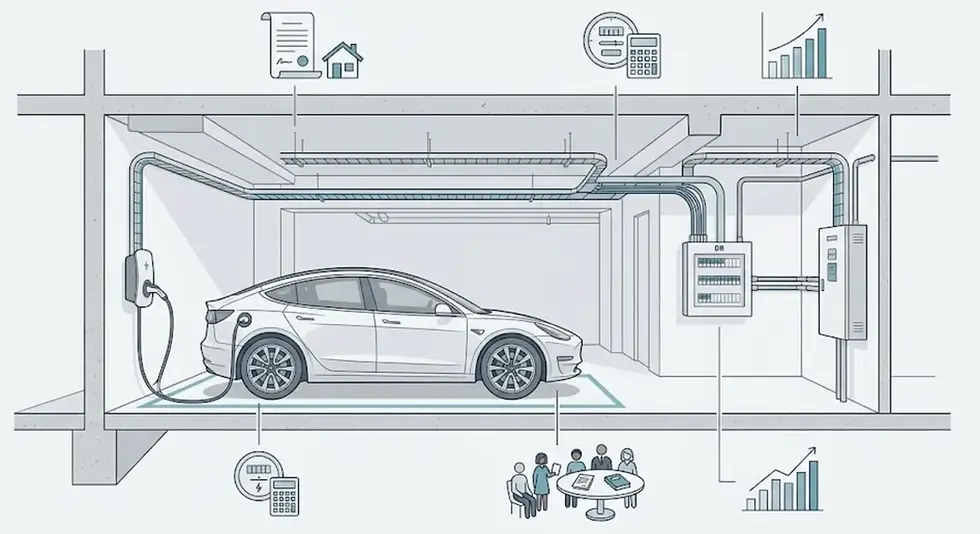
That distinction matters for EV charging because the equipment beside the vehicle is only one part of an installation. Cabling may need to cross common property, while switchboards and distribution equipment can be located elsewhere in the building.
A numbered parking bay or a statement in a sales listing therefore does not establish what electrical work can be carried out. Your solicitor or conveyancer can confirm how the strata plan and relevant rights apply to the particular car space.
For the electrical and infrastructure side of that picture, VeCharge’s overview of strata EV charging explains how charging can interact with common infrastructure, energy management and billing in apartment buildings.
2. Find out what EV charging arrangements already exist
Do not stop at asking whether there is a charger in the basement.
A useful pre-purchase check separates the physical infrastructure from the rules around using it. A building may have chargers, cable trays or distribution equipment already installed. It may also have a by-law dealing with future connections, electricity usage or cost recovery.
Under the current Strata Schemes Management Act 2015, installing electric vehicle charging stations is expressly given as an example of sustainability infrastructure. A sustainability infrastructure resolution passes where less than 50% of the value of votes cast are against it. The Act also provides that a by-law change has no effect until the required notification is lodged and recorded, and a notification cannot be lodged more than six months after the resolution.
Another rule may matter when reviewing what the building has already adopted. The NSW Government guidance on strata by-laws confirms that, from 1 July 2025, a by-law cannot prevent sustainability infrastructure solely because of its effect on external appearance, subject to the heritage exception.
You do not need to work through the approval process at this stage. As a buyer, you are trying to establish something more immediate: has the building already created a workable framework for EV charging, or would you be buying into a situation that still needs to be resolved?
3. Read what the owners corporation has already discussed
The registered by-laws show the formal position. The strata records can reveal the history behind it.
Look for references to EV charging motions, supplier quotations, consultant reports, building energy assessments, proposed switchboard works, metering, billing, load management and decisions about funding shared infrastructure.
This is particularly useful when someone tells you that the building is “looking into EV charging”. Meeting records can help distinguish a general conversation from an assessment that has actually been commissioned or a proposal that has reached a vote.
NSW Government’s record-keeping requirements for strata schemes cover documents such as meeting minutes, voting papers and contracts. Prospective purchasers can also arrange to inspect strata records with the necessary authority and fee.
If EV charging does not appear anywhere in the available records, avoid over-interpreting that absence. It does not demonstrate that the building cannot support charging. It tells you that there is less documented evidence of the issue having been investigated, costed or decided.
That is still useful information before committing to the property.
4. Ask whether electrical capacity has actually been assessed
A charger is the visible part of a much larger electrical system.
Switchboard capacity, wiring, historical peak demand and the number of vehicles likely to charge at the same time can all influence the appropriate design.
The NSW Government’s residential EV-ready guidance recommends a building energy assessment and identifies matters such as existing circuit breaker sizes, historical peak loads, energy-use patterns and spare capacity for EV chargers.
For a property you are considering, ask whether there is an electrical capacity assessment, maximum-demand report, building energy assessment, feasibility study or EV-readiness report.
If none is available, the conclusion should remain narrow: you do not yet have documented evidence showing how the building’s capacity for EV charging has been assessed.
Where multiple chargers need to operate within the power available to the building, dynamic load management can form part of the system by controlling how available capacity is distributed between active chargers. Whether that approach is appropriate still depends on the electrical conditions at the specific building.
This is one of the areas where a document can materially change the quality of your due diligence. “There should be enough power” and “an assessment has established the available capacity” are very different pieces of information.
5. Work out how charging would actually be paid for
Charging costs are easier to understand when they are separated into two categories.
One is the electricity consumed by the vehicle. The other is the infrastructure that enables charging: distribution equipment, cabling, meters, management software, maintenance and any shared system used by the building.
The NSW Government’s residential strata EV-ready quick reference guide illustrates how different charging approaches can involve different payment and cost-recovery arrangements.
In the records for the building you are considering, look for practical details. Is charging connected to an apartment’s existing meter? Does the system meter individual usage from common-property power? Is there a per-kWh charge, connection fee or recurring management cost? Who is responsible for maintaining the equipment?
The answer will not be identical across strata schemes.
VeCharge’s guide to EV charging payment models for strata looks at the main ways electricity usage and shared infrastructure costs can be allocated. Where the building needs individual metering and management of shared charging infrastructure, the available billing solutions are another part of the technical design.
For a buyer, the important issue is whether the financial model is already clear. A charger that can technically be installed is a different proposition from a charging arrangement whose ongoing costs have also been worked out.
6. Check whether the building has an embedded network
The building’s electricity supply arrangement can change the questions you need to ask.
An embedded network is referred to in NSW strata material as an exclusive supply network. It is a private network that can supply multiple lots with electricity or other utilities.
This became easier for buyers to identify from 1 April 2026. The NSW Government’s guide to the 2026 strata law changes confirms that Section 184 strata information certificates now need to include information about utilities supplied through an exclusive supply network. The certificate is commonly obtained as part of the purchase process.
Finding an embedded network does not tell you that EV charging will or will not work. It tells you something important about the electricity arrangement you are buying into and gives you a reason to establish how charging usage, retailers and billing would work at that particular property.
There can also be consequences beyond the charger itself. Under the Australian Government’s current Solar Sharer Offer eligibility rules, households supplied through an embedded network are not eligible for that offer.
So the useful due-diligence question is not whether an embedded network is inherently good or bad. It is whether you understand the supply arrangement before assuming the energy options will be the same as at another apartment building.
7. Base your decision on the law that exists today
One final trap is relying on a reform you have heard about rather than the law currently in force.
The Strata Schemes Legislation Amendment (Miscellaneous) Bill 2026 contains proposed changes relevant to EV charging. But as at 6 October 2026, the Parliament of NSW Bill record still lists it as being in the Legislative Council, awaiting the Minister’s second reading speech. It passed the Legislative Assembly on 11 February 2026 and received its First Reading in the Council on 12 February.
It has therefore not completed the parliamentary process or received assent.
For someone deciding whether to buy an apartment now, that distinction matters. Current building documents, existing infrastructure and the law already in force are the relevant basis for the decision. A proposed reform should not be used to fill an unanswered question about capacity, cost or the arrangements operating in the scheme today.
A practical EV due-diligence checklist before you buy
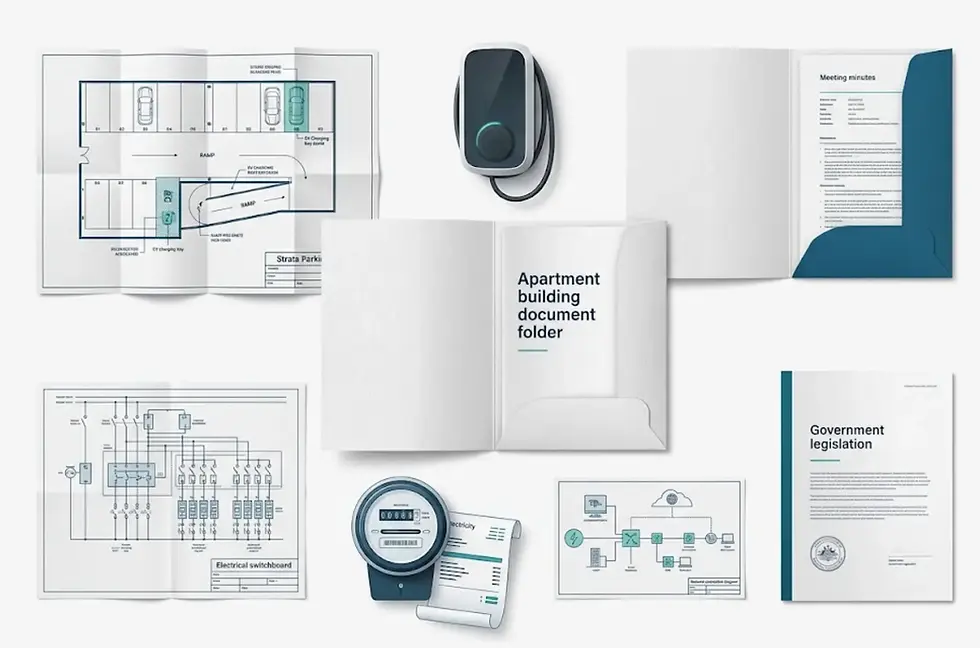
Before exchange, establish as much as you reasonably can about:
the parking-space boundaries and relevant strata rights;
existing chargers and shared EV infrastructure;
any registered EV-related by-law or formal arrangement;
recent owners corporation decisions about charging;
electrical capacity or EV-readiness assessments;
the method for measuring and paying for electricity;
infrastructure, software and maintenance costs;
any embedded or exclusive supply network; and
technical work or approvals that remain unresolved.
The purpose is not to turn every unresolved item into a reason to walk away. It is to know what you are actually taking on.
An apartment where the infrastructure, electrical capacity and payment arrangements have already been investigated presents a different set of unknowns from one where EV charging has never moved beyond informal discussion.
When a technical EV assessment becomes useful
A strata report can tell you what has been recorded. A by-law can tell you what has been formally adopted. Neither can establish electrical conditions that nobody has assessed.
Technical input becomes particularly useful when charging at home is important to your purchase and the available documents leave material questions unanswered. For example, when spare capacity is unclear or the building has no coordinated EV charging infrastructure.
At that point, the question is less about whether a charger physically fits beside the car and more about what electrical pathway the building can realistically support.
This article provides general information only and does not constitute legal, conveyancing or electrical advice. Buyers should obtain professional advice appropriate to the property and their circumstances.