
The EV Usage Policy Every Strata Building Needs Before the First Charger Switches On
The vote has passed. The by-law is registered. The installer is booked. Everything that needed to happen before the charger went on the wall has happened.
Almost everything.
The piece buildings consistently leave until after installation, once the first dispute has already surfaced, is the usage policy. Not the by-law, which covers legal ownership, cost allocation and installation standards. The operational policy: who can use the shared charger, when, for how long, what happens when it's occupied, and what a resident does when something stops working.
These aren't complicated questions. Left unanswered before the system goes live, they become exactly the kind of resident friction that makes committees regret the whole project.
By-Law vs Usage Policy at a Glance
By-Law | Usage Policy | |
Covers | Installation approval, cost allocation, maintenance responsibility, OC rights | Access, booking, bay rules, fault reporting, visitor access |
Adopted via | Special resolution, registered with NSW Land Registry Services | Committee decision, no general meeting required |
Changing it | Requires a new by-law process | Updated by the committee as needs evolve |
Individual vs Shared Systems: Different Problems, Different Policies
For individual lot installations — a resident with their own dedicated charger, connected to their own meter, in their own car space — most operational questions are self-managing. The resident owns the charger, pays their own electricity bill, handles their own usage. OC policy involvement is minimal: the by-law covers installation standards and maintenance, and that's largely where it ends.
Shared common property chargers are different. Multiple people using a shared resource need defined rules before launch: booking, priority, fault reporting, visitor access. All of it needs settling before the first resident plugs in, not after the first argument.
Access: Who Can Use the Chargers
The first question is straightforward: who's registered to use the system?
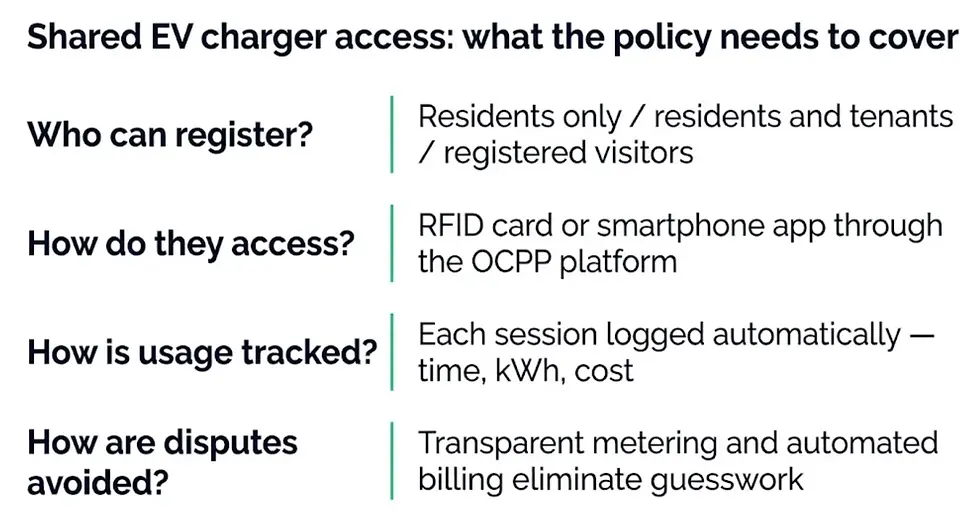
In most buildings, shared EV chargers are installed for resident use. The policy should state this clearly, especially in buildings with both owner-occupiers and tenants, where by-law eligibility can differ. OCPP-compliant charging platforms manage access through RFID cards or smartphone apps, so access control is a software registration question, not a physical security one. The policy needs to cover the registration process, what information residents provide, and who administers it.
For buildings running booking systems, the rules need defining too: how far in advance a booking can be made, whether sessions can be cancelled, and whether there's a consequence for no-shows.
Overnight Charging Simplifies the Policy Debate
The session-length question causes more anxiety in policy discussions than it deserves.
A 15A Level 1 socket running at 3.6kW adds roughly 20 kilometres of range per hour. Over an eight-hour overnight charge, that's around 160 kilometres, more than four days of average Australian driving. Even a standard 10A power point adds around 150 kilometres overnight.
For most buildings, the practical answer is overnight scheduled charging: residents plug in after dinner, the platform charges vehicles during off-peak hours, and bays are free by morning. Time-of-use scheduling is standard in most OCPP management systems. It cuts electricity costs and resolves bay congestion by concentrating demand in the hours when parking pressure is lowest. Buildings running this way generally find specific session-length limits unnecessary.
Bay Rules: After the Car Has Charged
The bay conflict is real and worth naming directly: a resident whose vehicle finished charging at 2am but is still occupying the bay at 7pm is blocking someone who needs to charge that evening. Three approaches are used in Australian buildings:
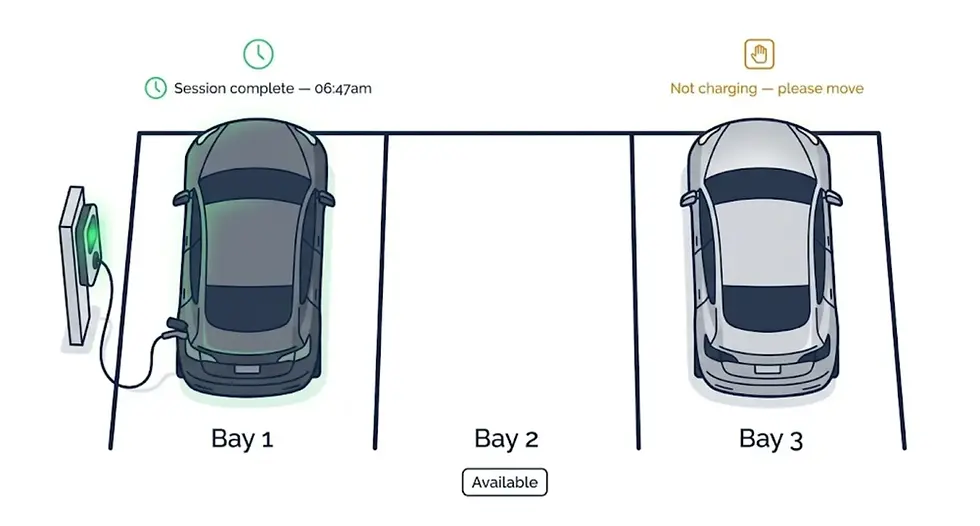
Shared EV zones. Two or three bays designated for charging, accessible to any registered resident by rotation or booking. Works well when visitor or casual bays can be repurposed. Each resident is metered separately and pays only for their own usage.
Time limits after session completion. The platform notifies the resident when charging finishes. The policy sets a grace period — typically 30 to 60 minutes — after which some buildings apply a small idle fee, collected automatically through the billing system.
Dedicated charging bays, separate from assigned parking. Where the layout allows it, residents park in their own space and connect to nearby infrastructure. This avoids the conflict entirely: the bay doesn't belong to anyone, so nobody's blocking anyone.
The policy needs to nominate one of these, document the consequence for non-compliance, and make sure residents know the rule before they start using the system.
Guest and Visitor Vehicles
Most policies focus on residents. Visitor charging catches committees off guard.
As EV adoption grows, visitors, contractors and guests increasingly arrive in EVs expecting somewhere to charge. The simplest approach is one or two visitor-bay chargers with public access: a QR code that starts a pay-per-use session without prior registration. It handles the visitor scenario without creating ongoing administrative overhead.
If the building's chargers are resident-only, the policy should say so explicitly, and the strata manager should know what to say when a visitor asks. "Not available to visitors" is a complete answer. It just needs to exist before someone asks.
Fault Reporting and Maintenance
When a shared charger stops working, residents need to know what to do. This is one of the most consistent sources of strata manager frustration in buildings that launch without it documented.
For shared common property chargers, the OC carries maintenance responsibility. The process should be: report through the platform app, which typically generates a fault ticket automatically, or contact the strata manager directly. The policy should name the service provider and their response time commitment, which means identifying both before launch.
Individual charger faults are the resident's own problem. The OC isn't responsible for hardware the resident installed in their own lot, and the policy should say so clearly, so it doesn't become a committee question every time a private charger breaks.
E-Bikes, Scooters and Other Lithium Devices
This section matters more in 2026 than it did three years ago.

E-bikes, scooters and other lithium-ion battery devices are now common in apartment buildings. Some buildings are already restricting where these can be stored and charged: prohibiting charging in hallways, common areas and storage cages. The EV charging policy should draw this line explicitly too: EV charging bays are for registered road vehicles only, and personal mobility devices shouldn't be connected to EV charging infrastructure.
Two Documents, Two Jobs
The by-law and the usage policy don't need to be the same document, and they shouldn't be. The by-law is the legal framework: registered, hard to change, focused on rights and cost allocation. The usage policy is operational: adopted by the committee, easy to update as the building's needs evolve, focused on day-to-day access.
NSW Government guidance on strata EV charging recommends preparing both before installation. Both need to exist before the first session, not after the first complaint.