
ESG Reporting for Strata Buildings: What EV Infrastructure Can Measure

Since 1 July 2025, the agenda for every NSW strata AGM must include an item considering environmental sustainability within the scheme. This includes the common property's annual energy and water consumption and expenditure.
For strata schemes planning EV charging, metering is therefore more than a billing issue. A properly configured charging system can record electricity consumption and, depending on the equipment and software, session and interval data. Those records can be used for cost recovery, electrical capacity management and the scheme's own sustainability reporting.
NSW strata requirements for sustainability infrastructure
The strata reforms that commenced on 1 July 2025 introduced several requirements relevant to sustainability projects.
A by-law has no force or effect to the extent that it prevents sustainability infrastructure from being installed solely to preserve the external appearance of a lot or common property. The rule does not apply to heritage-listed common property or common property within a heritage conservation area.
Owners corporations must also consider environmental sustainability at each AGM, including annual common-property energy and water consumption and expenditure.
When estimating the amount required for the capital works fund, the owners corporation must consider expenditure on the installation, replacement or repair of infrastructure, fixtures and fittings used for the sustainable use of the scheme. NSW Government guidance gives electricity meters and solar panels as examples.
EV charging falls within the Act's definition of sustainability infrastructure because the definition includes infrastructure that facilitates sustainable forms of transport.
The voting threshold is different from a standard special resolution
The lower voting threshold for sustainability infrastructure predates the 2025 reforms.
Under the Strata Schemes Management Act, a standard special resolution passes if no more than 25% of the value of votes cast is against it. For a sustainability infrastructure resolution, less than 50% of the value of votes cast may be against the resolution. Voting value is based on unit entitlement.
A sustainability infrastructure resolution can cover financing, changes to common property needed for the installation and relevant by-law changes.
Before approving one, the owners corporation must consider the project cost, expected running and maintenance costs, who will own, install and maintain the infrastructure, and which lots will have access to it.
AASB S2 does not automatically apply to a strata scheme
Australia's mandatory climate-reporting regime is separate from NSW strata requirements.
The federal regime operates under the Corporations Act and AASB S2. Group 1 entities began reporting for financial years starting on or after 1 January 2025. Group 2 applies from 1 July 2026 and Group 3 from 1 July 2027.
Whether an entity must report depends on its Chapter 2M reporting obligations and the applicable corporate-size, NGER or asset thresholds.
The fact that a property is strata-titled does not itself trigger AASB S2 reporting. The indirect connection is more relevant: a company, fund, owner, landlord or tenant that is subject to climate-reporting requirements may need information from its value chain or property portfolio. ASIC notes that reporting entities may seek information from other businesses in their value chains.
That does not mean every item of building energy data belongs in an AASB S2 report. Its relevance depends on the reporting entity, its reporting boundary and materiality assessment. But reliable metered data is easier to work with than consumption that has to be reconstructed later.
What an EV charging system can measure
The available data depends on the system installed.
A networked, metered charging system can record the electricity delivered to chargers. Depending on its configuration, it can also record individual charging sessions, charger or user IDs, timestamps and interval consumption.
A building-level energy management system can provide additional information about aggregate EV demand and how charging interacts with the building's available electrical capacity.
Typical measures include:
annual EV charging consumption in kWh
consumption by charger or user
maximum EV charging demand
charging during defined peak periods
electricity costs or amounts recovered from users.
Dynamic load management can limit the combined charging load and distribute available capacity between connected chargers. This can reduce the amount of additional electrical capacity required for an EV charging installation.
It does not guarantee that a switchboard or supply upgrade will never be needed. That depends on the building's existing infrastructure, peak demand and expected charging load. NSW guidance recommends checking electrical capacity before selecting the charging design.
Solar can also be incorporated into the charging system. However, charger consumption alone does not show how much charging energy came from onsite solar. Measuring that contribution requires the necessary site metering, interval data or energy-management controls.

Metering and cost recovery
NSW guidance recognises several ways to allocate EV charging costs.
Where charging equipment is connected to an apartment's existing electricity meter, its consumption is included in the resident's normal electricity bill.
For common-property systems, the owners corporation can use a flat fee, metered usage or an outsourced charging and billing platform.
With suitable metering, electricity consumption can be allocated by kWh rather than recovered through a general fee.
The billing model should be settled as part of the strata approval and EV by-law, including who pays for electricity, equipment, software, maintenance and administration.
Where electricity is being sold or on-supplied to residents or other users, the arrangement may also need to be checked against applicable energy-retailing and exemption requirements.
EV charging and NABERS
EV charging also needs to be treated correctly where a building uses NABERS.
Under the current NABERS Metering and Consumption Rules, energy associated with EV charging does not form part of the minimum energy coverage where the applicable NABERS rules permit its exclusion.
To exclude that consumption, the building needs suitable metering or qualifying consumption data from a third-party charging provider. NABERS specifies information such as charger identification, charging-session dates and times, and energy consumption for each session.
If the necessary sub-metering or third-party data is not available, the EV charging consumption cannot simply be removed from the rating calculation.
Check the term of EV charging agreements
Contract structure matters when a third party installs or operates charging infrastructure.
Section 132A of the Strata Schemes Management Act covers agreements for the supply of utilities, and the statutory definition now expressly includes electric vehicle charging.
NSW Government guidance states that the utility-agreement expiry rules apply to EV charging agreements entered into by an owners corporation.
For relevant agreements entered into on or after 1 July 2025, the agreement expires at the conclusion of the first AGM if it was executed before that meeting, or otherwise three years after it commenced, unless it ends earlier.
A proposed charging-as-a-service or other long-term arrangement should therefore be reviewed against section 132A before the owners corporation commits to the contract. The legal treatment will depend on the structure and terms of the particular agreement.
Installing chargers does not prove an emissions reduction
An EV charger is electrical infrastructure. Its installation alone does not establish that the building's greenhouse gas emissions have fallen.
Charging adds electricity consumption. The emissions associated with that consumption depend on factors including the source of electricity, charging times, onsite generation and the reporting methodology being used.
Claims about emissions reductions should therefore be based on measured data and a defined calculation method rather than on the presence of charging equipment.
For an owners corporation, the more immediate value is operational: EV consumption can be identified separately, charging demand can be controlled, costs can be allocated to users and the resulting data can be retained for future reporting and planning.
Before installing EV charging
Start with the building's electrical capacity and demand profile. That establishes how much charging load the existing infrastructure can accommodate and whether load management or electrical upgrades are required.
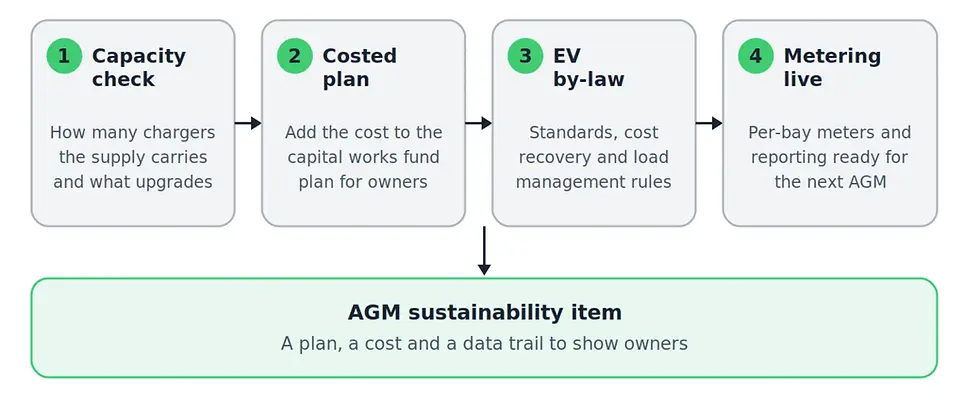
Where the owners corporation will incur capital expenditure, include the expected costs in capital works planning.
Prepare the required resolutions and EV by-law before installation. They should deal with ownership, installation, maintenance, access, billing, cost recovery and load management.
Metering should be specified at the same stage. If the scheme expects to report annual EV consumption, usage by resident, peak demand or solar contribution later, the system needs to collect the required data from the start.